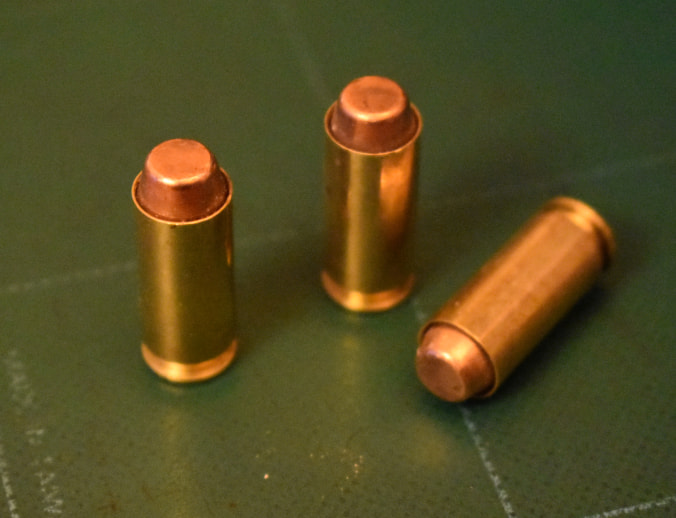
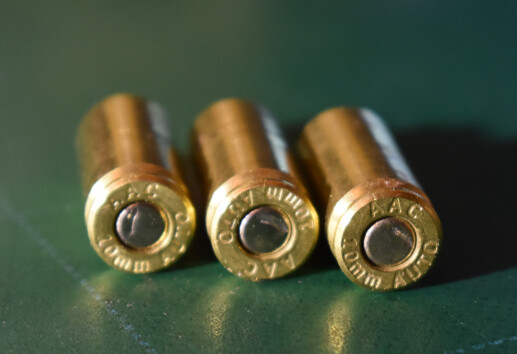
I find all kinds of interesting things when I collect range berries. Last week I picked up these three FTFs, but FTF seems to be the least of the problem. In fact, it may have saved them.
As best I can tell, the cases were not resized, flared, chamfered or crimped. There was hardly enough neck/case tension to keep the bullet in place during recoil and/or chambering.
The FTF was an entirely different issue and it probably saved whomever reloaded these rounds from a very bad day. The pressure spike from excessive bullet setback would be dangerous, if not catastrophic. It appears the factory primer was crimped and the reloader did not remove it during case prep. This caused the primer to not fully seat and “float”, thus absorbing the impact of the firing pin.
Speaking of the firing pin, what pistol uses a rectangular firing pin? It almost looks like a rimfire pin strike. I can’t tell if it was just a weak strike, or if some swipe was involved.
could you take one apart and weigh that bullet? I am curious to see if it is a 180 grain FMJ or plated… If that is bullet setback he has a real problem and needs to stop reloading altogether.
PSA doesnt sell that ammo anymore so I cant compare it to anything. Why would the primer pockets be crimped? Doesnt make any sense…those firing pin marks may not be firing pin marks at all…those marks look like primer pin smilies. If he didnt remove the crimp I dunno if you could even get the primer in there. I could be wrong and they could be factory rounds but I doubt it.
180gr FMJ-FP, also 7.8gr of some semi spherical powder that may or may not have been the right powder. who knows…
There is so little neck tension I can push the bullet in part way.
Definitely not factory rounds, though AAC did have a bad rep for a while because of bullet setback in some cartridges. Their match ammo was supposed to be very good tho.
AAC brass is made by JAG (Jagemann), in fact, some AAC ammo came to PSA with JAG headstamps mixed in. JAG is a NATO supplier, so they probably crimp some or all 9mm primers. I guess it depends on whether JAG sent AAC primed brass, ready to load, of if AAC puts the crimp on themselves.
so the only explanation would be either poor resizing of the case.There should be enough neck tension if properly resized without crimping but I always add a little crimp.
Except for my match .223 ammo, EVERY round I make gets run thru a Lee Factory Crimp die.
In addition, the semi-auto rounds go thru the Lee Bulge Buster (which uses the body of the Factory Crimp die)
And every completed round must successfully fit a case guage before it goes into inventory.
Remember, as a reloader YOU ARE THE QUALITY CONTROL GUY.
And also the guy who will suffer the consequences of making defective ammo. Side effects may include death or disfigurement plus loss of assets like valuable firearms.
I never had to use the bulge buster but every round I make goes through the Lee factory crimp die and the checked on a caliber specific gauge…every single round. I dont have ANY issues with this setup.