ANJRPC v. Platkin - Assault Weapons Ban - 3rd Circuit Court of Appeals

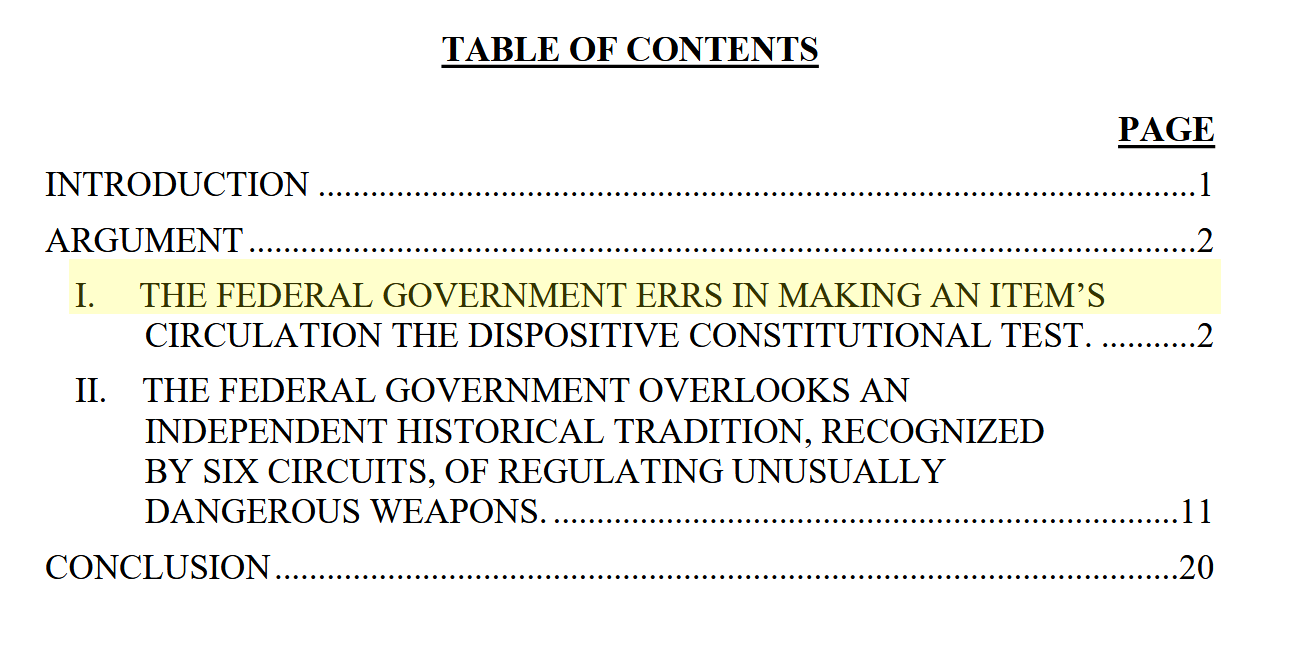
As this is a Constitutional challenge, the common use test is for the whole country, not just NJ because the Constitution applies to the whole country equally. Just because NJ banned a firearm and therefore made it not in common use in NJ, doesn’t mean they can justify their unconstitutional law because it is common in the country as a whole.

This was discussed in the Heller decision, IIRC. The dissent said that this means that if a new, dangerous firearm (all firearms are inherently dangerous which is why the unusual part is so critical) gets sold a lot before the government can ban it, it means the item cannot be banned. The majority said “yep”.

They also called out the circular argument that a particular firearm is rare because it was banned leading to the conclusion that it is not in common use and can therefore be banned. This is nonsense and the ban cannot be justified that way.

1 Like

Apparently there is a vacancy waiting on appointment of Jennifer Mascott:

1 Like

Some “premium” content from….elsewhere:

Analysis: Is an ‘Assault Weapon’ Ban Circuit Split on its Way? [Member Exclusive]

Thanks to an unusual judicial maneuver, gun-rights advocates will soon have their best shot yet at securing the ever-elusive “assault weapon” ban circuit split they’ve been longing for.

On Thursday, the full Third Circuit Court of Appeals decided to take a consolidated group of lawsuits challenging New Jersey’s “assault weapon” and “large capacity” magazine bans en banc. The court did so sua sponte, meaning on its own accord, less than two months after a three-judge panel heard oral arguments in the case, and before the panel even issued an opinion. That means the full court’s eventual decision will be the first, and only, appellate opinion on the matter.

While rare, such rehearing orders are not unheard of, not even for this particular issue. The Fourth Circuit Court of Appeals, for instance, famously did the same last January in a case dealing with Maryland’s “assault weapon” ban. The en banc Fourth Circuit ultimately upheld Maryland’s ban, and the Supreme Court declined a request to review that decision this summer.

What makes the Third Circuit’s order stand out, however, is that it almost appears to be the reverse situation of the Fourth Circuit in Snope.

There, a three-judge panel comprised of two Republican appointees and one Democratic appointee was initially tasked with hearing the challenge to Maryland’s law before the en banc court opted to intervene. According to at least one Fourth Circuit judge, that was a maneuver by the majority Democratic-appointed court to head off a likely ruling against Maryland’s ban.

“After hearing the case in December 2022, the initial panel majority reached a decision and promptly circulated a draft opinion,” Judge Julius Richardson wrote last year. “Yet, for more than a year, no dissent was circulated. The panel thus held the proposed opinion in accordance with our custom that majority and dissenting opinions be published together. One year later, as the proposed opinion sat idle, a different panel heard arguments in United States v. Price, which also involved interpreting and applying Bruen. The Price panel quickly circulated a unanimous opinion that reached a conclusion at odds with the Bianchi majority’s year-old proposed opinion. Facing two competing proposed published opinions, the court declined to let the earlier circulated opinion control. Rather, in January 2024, we invoked the once extraordinary mechanism of an initial en banc review.”

By contrast, the three-judge panel that heard the challenges to New Jersey’s law was comprised of two Democratic appointees and one Republican appointee. Meanwhile, with the confirmation of Donald Trump’s recent judicial appointee, Emil Bove, last month, the en banc Third Circuit is now a 7-6 Republican-appointed court.

Granted, the Third Circuit’s en banc order didn’t offer any explanation as to why it is taking a similar course of action. So, it’s not a guarantee that the atypical order is geared toward reaching a particular outcome (appearances notwithstanding).

Furthermore, the presence of more Republican appointees is by no means a guaranteed win for gun-rights advocates. After all, both the Seventh Circuit opinion upholding Illinois’ assault weapon ban and the Fourth Circuit’s upholding Maryland’s ban were either authored or joined by prominent Republican-appointed jurists.

Still, the odds of securing a ruling striking down an AR-15 ban are better for gun-rights advocates in the Third Circuit than anywhere else in the country, where predominantly liberal-leaning circuits have unanimously ruled against them. And they could grow even better for them by the time the case comes up for rehearing in mid-October.

At least one other Republican appointee, Senior Judge D. Brooks Smith, appears to have elected to sit on the en banc panel, giving it a potential 8-6 conservative tilt. Additionally, President Trump announced the nomination of law professor Jenn Mascott to fill the final vacancy on the Third Circuit last month–though it is unclear if she will be brought up for a confirmation vote in time for the court to hear oral arguments.

That means gun-rights advocates could stand to lose one or even more conservative judges on the question and still potentially end up with the first-ever federal circuit split over the constitutionality of assault weapon bans.

In a statement commenting on the Court’s denial of the Maryland case, Justice Brett Kavanaugh expressed a desire for further appellate court percolation on the question of semi-automatic rifle bans before promising action soon.

“Opinions from other Courts of Appeals should assist this Court’s ultimate decisionmaking on the AR–15 issue,” Kavanaugh wrote. “Additional petitions for certiorari will likely be before this Court shortly and, in my view, this Court should and presumably will address the AR–15 issue soon, in the next Term or two.”

The Third Circuit’s eventual decision on New Jersey’s AR-15 ban, thanks to its recent maneuvering, should give Kavanaugh and the rest of his colleagues a chance to make good on that promise.

I’m liking this :+1:

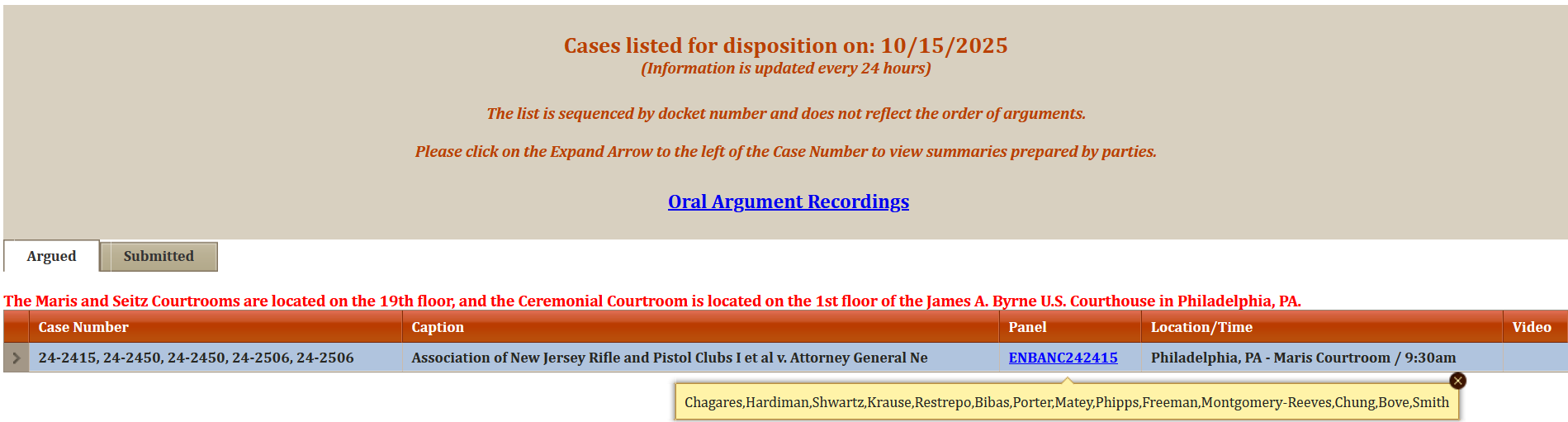
The En Banc Panel (with Bove and Sr. Judge Smith the count is now 14 judges) is:

Bibas - Trump Appointee - 2017 - Stephanos Bibas - Wikipedia - (+1)
Bove - Trump Appointee - 2025 - Emil Bove - Wikipedia - (+1)
Chagares - Bush Appointee - 2006 - Michael Chagares - Wikipedia - (+1)
Chung - Biden Appointee - 2022 - https://en.wikipedia.org/wiki/Cindy_K.\_Chung - (-1)
Freeman - Biden Appointee - 2022 - https://en.wikipedia.org/wiki/Arianna_J.\_Freeman - (-1)
Hardiman - Bush Appointee - 2007 - Thomas Hardiman - Wikipedia - (+1)
Krause - Obama Appointee - 2014 - Cheryl Ann Krause - Wikipedia - (-1)
Matey - Trump Appointee - 2018 - Paul Matey - Wikipedia - (+1)
Montgomery-Reeves - Biden Appointee - 2022 - Tamika Montgomery-Reeves - Wikipedia - (-1)
Phipps - Trump Appointee - 2018 - https://en.wikipedia.org/wiki/Peter_J.\_Phipps - (+1)
Porter - Trump Appointee - 2018 - https://en.wikipedia.org/wiki/David_J.\_Porter\_(judge) - (+1)
Restrepo - Obama Appointee - 2013 - https://en.wikipedia.org/wiki/L.\_Felipe_Restrepo - (-1)
Shwartz - Obama Appointee - 2012 - Patty Shwartz - Wikipedia - (-1)
Smith - Bush Appointee - 2001 - https://en.wikipedia.org/wiki/D.\_Brooks_Smith - (+1)

+1 / -1 scoring based solely on (D) or (R) president appointment, need to research further into their past 2A stances.

With current scoring it looks like a +2 overall.

1 Like

Grok.com analysis of judges based on question “What is the Second Amendment decision record of 3rd circuit judge …”:

Bibas - Overall Record: 3 pro-gun rights votes (dissents/joins striking down or limiting bans) vs. 2 upholding regulations (but with caveats for as-applied challenges). No evidence of Bibas endorsing “interest-balancing” or deference without historical grounding, marking him as one of the more Second Amendment-sympathetic judges on the Third Circuit.

Bove - Expected Approach: Based on his originalist leanings (evident in confirmation testimony emphasizing textualism), Bove is likely to scrutinize modern regulations for historical analogues, similar to colleagues like Judge Stephanos Bibas. No evidence indicates extreme positions for or against gun rights.

Chagares - Pro-Second Amendment Lean: Chagares’s sole recorded vote aligns with robust protection of individual rights, rejecting overbroad federal restrictions absent historical precedent. This places him in the Third Circuit’s conservative majority on gun issues, similar to Judge Stephanos Bibas.

Chung - Pro-Second Amendment Lean: Chung’s vote in Range supports limiting categorical bans, rejecting blanket felon disarmament absent historical evidence. This mirrors the circuit’s conservative bloc (e.g., Judges Bibas, Hardiman) while fitting her prosecutorial experience in weighing public safety against rights.

Limited Record: With only one published vote and one pending case, her jurisprudence is nascent (less than 2.5 years on the bench). No pre-Bruen opinions or state regulation challenges (e.g., NJ/DE bans) involve her directly.

Freeman - Pro-Second Amendment Lean: Freeman’s vote in Range favors individualized assessments over categorical bans, aligning with the Third Circuit’s conservative-leaning bloc (e.g., Judges Hardiman, Bibas) in limiting § 922(g)(1) post-Bruen. Her argument questions in Range highlight rigorous historical scrutiny, potentially favoring rights in future as-applied claims.

Limited Record: Nearly three years on the bench, but only two involvements— one substantive (pro-rights) and one procedural. No dissents, concurrences, or state regulation cases (e.g., NJ/DE assault weapon bans) feature her prominently. Her defender background suggests sympathy for challenges to overreach in criminal disarmament.

Hardiman - Pro-Second Amendment Stance: Hardiman consistently votes to protect individual gun rights, striking down or limiting federal bans in as-applied challenges (Binderup, Range) and demanding historical evidence for restrictions (Delaware, Harris). His pre-Bruen rulings (Marzzarella, Binderup) laid groundwork for the circuit’s post-Bruen shift toward stricter scrutiny.

Historical Rigor: Hardiman’s opinions reject modern “interest-balancing” (e.g., public safety deference) and require regulations to align with Founding-era practices. He has never upheld a blanket disarmament without historical grounding.

Overall Record: Of six cases, Hardiman voted pro-gun rights in four (striking down/limiting bans in Binderup, Range; dismissing speculative challenges in Plato to avoid diluting rights claims) and upheld narrow regulations in two (Marzzarella, Harris) only with historical analogues. Delaware’s denial of injunction left merits open, suggesting potential for future pro-rights votes.

Krause: Balanced Approach with Rights Lean in As-Applied Contexts: Krause upholds regulations with strong historical roots (e.g., sensitive places in Platkin, felon bans pre-Rahimi) but supports remands for evidence (Drummond) and individualized relief (Range 2024), rejecting categorical exclusions without “dangerousness” proof. Her Rahimi-influenced concurrence marks a pro-rights evolution, prioritizing rebuttable processes over permanent disarmament.

Historical Emphasis: Consistent with Bruen, Krause demands analogues across eras (Founding to Reconstruction), criticizing narrow 1791-only limits in dissents (e.g., Lara v. Commissioner, 2024, where she dissented from denial of en banc on age-based handgun purchase bans for 18-20-year-olds, arguing Reconstruction sources relevant).

Overall Record: Of five cases, Krause voted to uphold restrictions in two (Range 2022 panel; Platkin majority), dissented against rights expansion in one (Range 2023), but favored rights in two post-remand/developments (Drummond remand; Range 2024 concurrence). Her authored opinions (three) blend scrutiny of outliers with deference to tradition, positioning her as moderate-liberal on the Third Circuit.

Matey - Scope: Matey’s Second Amendment involvement is narrow, focusing on challenges to magazine capacity limits and lifetime firearm bans for non-violent offenders. No cases were identified involving assault weapons bans, carry restrictions, or other common gun rights issues.

Ideological Lean: Matey consistently advocates for robust Second Amendment protections, critiquing post-Heller means-end scrutiny (pre-Bruen) and favoring the Bruen framework’s emphasis on text, history, and tradition. His natural law-infused reasoning aligns with originalist interpretations, positioning him as a defender of individual gun rights against expansive regulations. Conservative legal analysts have praised this as a “commitment to defending the 2nd Amendment.”

Montgomery-Reeves
: Judge Montgomery-Reeves’ Second Amendment record is sparse but leans toward a restrictive interpretation of disarmament laws in non-violent contexts. Her single vote in Range supported a Second Amendment claim, contributing to a landmark ruling that limits the federal felon-in-possession ban’s scope. This decision has been cited in subsequent challenges (e.g., in the Fifth and Eleventh Circuits) and underscores a cautious, history-based approach to gun regulations. Given her brief federal service (under 2.5 years as of the current date), her record may evolve with future cases.

Phipps: Judge Phipps’ Second Amendment record is minimal but supportive of robust protections in the Range decision, where he joined a strong majority limiting felon disarmament for non-violent individuals. His questioning during arguments reflected a critical view of outdated government positions on the Amendment’s scope, aligning with Heller and Bruen. This stance suggests a textualist, history-focused approach favoring individualized rights over blanket restrictions. With limited caseload exposure, his record may expand as the Third Circuit handles more gun regulation appeals.

Porter: Judge Porter’s Second Amendment record demonstrates a strong originalist bent, consistently applying Bruen’s history-and-tradition test to favor gun rights where historical evidence is lacking. In Range, his majority vote and concurrence supported narrowing felon bans for non-violent offenders, advancing individual protections. In Koons/Siegel, his dissent robustly defended public carry against expansive “sensitive places” laws, critiquing weak analogues and urging stricter scrutiny. This pattern—limited but pro-Second Amendment—reflects his Federalist Society ties and Trump-era appointment, positioning him as a potential swing vote in future en banc or Supreme Court-influenced cases. His record may grow as the Third Circuit addresses ongoing Bruen challenges.

Restrepo: Judge Restrepo’s Second Amendment record, spanning three cases, demonstrates a consistent preference for upholding restrictions on firearm possession and carry, particularly for those with criminal histories or youth status. In Binderup and Range, his dissents supported categorical felon disarmament under historical traditions, critiquing individualized expansions as overly broad. His Pennsylvania v. SAF dissent similarly prioritized public safety in emergencies over presumptive youth rights. This pattern—deferential to government burdens post-Bruen—aligns with his Obama appointment, criminal defense background, and emphasis on community safety. With a modest caseload in this area, future assignments could refine his views amid ongoing Bruen challenges.

Shwartz: Judge Shwartz’s Second Amendment record supports restrictions on firearms, balancing individual rights with public safety through historical deference and empirical evidence. In Association of New Jersey Rifle, she upheld magazine limits pre-Bruen. Her Binderup dissent and Range panel affirmance/ en banc dissent favored categorical felon disarmament, critiquing as-applied expansions as overly broad and contrary to precedent. This pattern—consistent across three cases—aligns with her Obama appointment, prosecutorial background, and emphasis on preventing gun violence. Post-Rahimi, her views may influence future challenges, but her limited exposure in this area (fewer than other judges) suggests evolution with more Bruen caseloads.

Smith: Judge Smith’s Second Amendment record, across three cases, balances presumptive validity of restrictions with limited as-applied relief, prioritizing historical disarmament traditions and public safety. In Binderup, his lead opinion introduced a “dangerousness” framework favoring the government but allowing narrow exceptions. His Range dissents defended categorical felon bans against Bruen-driven expansions. Joining the majority in Pennsylvania v. SAF upheld emergency age restrictions, reflecting deference to crisis regulations. This conservative pattern—pro-restriction with historical grounding—aligns with his G.W. Bush appointment, prosecutorial background, and senior status.
He’ll appeal it if it happens and he’s still in office. This isn’t a fall on your sword situation as a win for us creates a circuit split and accepting it delays nothing given the other cases in the pipe.

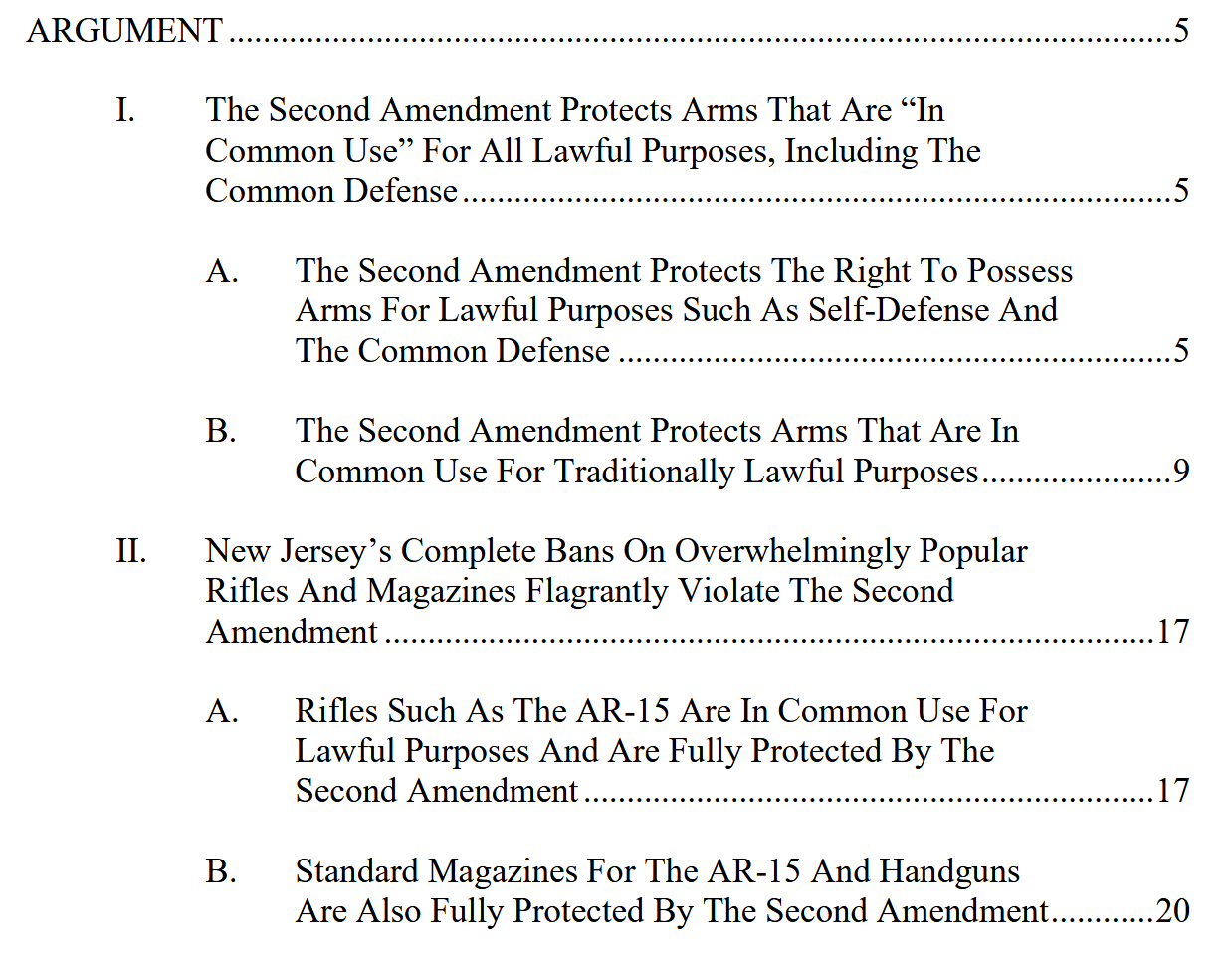
BRIEF FOR THE UNITED STATES AS AMICUS CURIAE IN SUPPORT OF APPELLANTS/CROSS-APPELLEES ON REHEARING EN BANC

Dis gonna be good!

Where’s the Platkin-Cam so we can see his face as he reads it?

2 Likes

I’d like to see the M1 Carbine off the banned list. My Garand want’s a little brother.

1 Like

Can we get a hallelujah

1 Like

waiting for an M1 carbine as well but I’m 63yo now so just dont think thats gonna happen, i’ll be 79 in 2041.

https://share.newsbreak.com/f2z7a4m8

I saw that pop up on the newswire. Will the DOJ have any muscle on this?

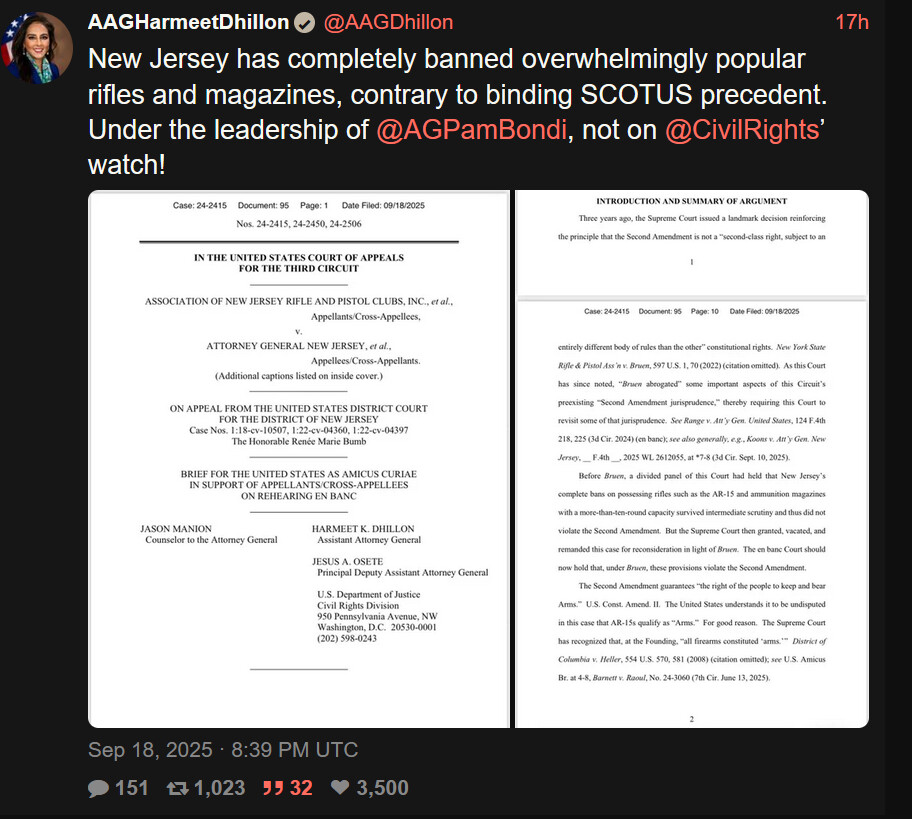
…"The Department of Justice filed an amicus brief Thursday with the U.S. 3rd Circuit Court of Appeals urging the full court to strike down New Jersey’s bans on AR-15-style rifles and magazines holding more than 10 rounds, arguing the categorical prohibitions violate the Second Amendment.

A 2-1 panel of the Philadelphia-based appeals court ruled last week that a lower-court judge erred in striking down the state’s restrictions under the Supreme Court’s 2022 Bruen decision. That landmark ruling reshaped gun laws nationwide by requiring any firearm regulation to be consistent with the nation’s historical tradition, reinforcing that the Second Amendment is not a “second-class right.”

In Thursday’s brief, the DOJ argued that legislatures “may not completely ban arms that are in common use among law-abiding citizens for lawful purposes,” and that New Jersey’s “complete bans on possessing rifles such as the AR-15 and magazines holding more than 10 rounds violate the Second Amendment.”

1 Like

LFG!

It’s time to get this shit straightened out for good.

5 Likes

I hope this is streamed somewhere online. If someone finds it post it up. Ill get the popcorn and beer ready to laugh my ass off.

1 Like

Mattykins ain’t so happy about that Amicus from the USA…

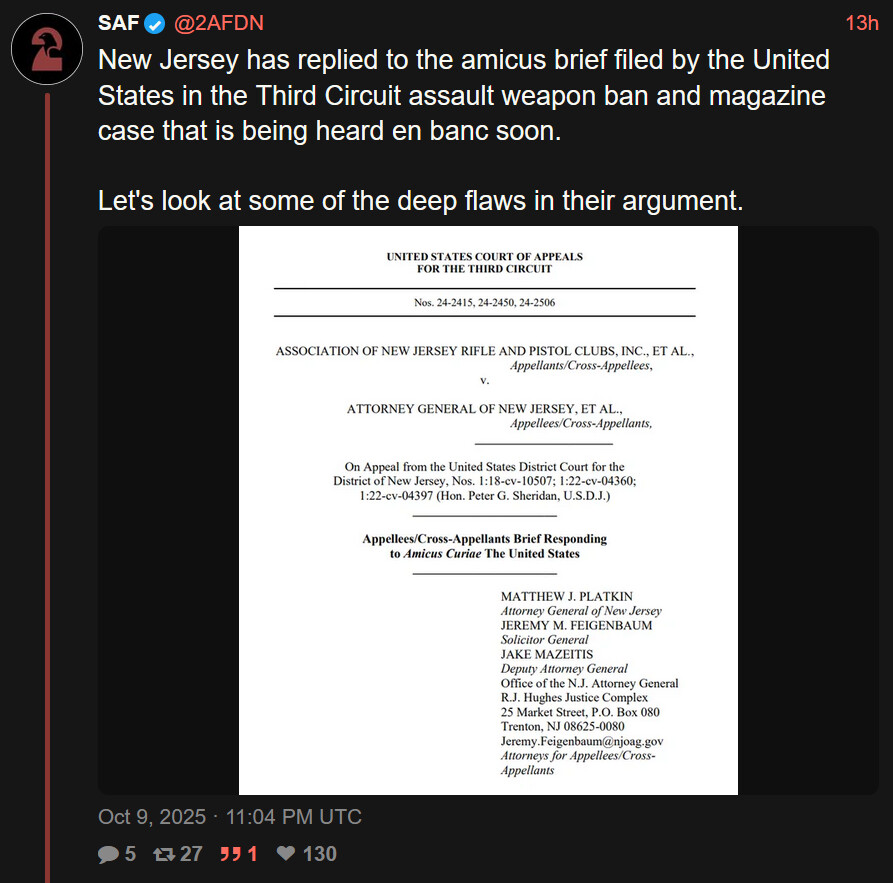
The PLATKIN STRIKES BACK!:

2 Likes

SAF Opines on Platkin’s Brief (much more via the links below):

https://x.com/2AFDN/status/1976423506666717219#m

https://xcancel.com/2AFDN/status/1976423506666717219#m

1 Like